Wednesday, January 1, 2020

Thoughts on the New Year, 2020, reflections on 2019


For me, every new year is informed by what happened the year before.  Here are some of the highlights I've been thinking about from 2019:
  • Paganoonoo was started 5 years ago!  My article in Threads Magazine came out in very early 2015. Many patterns and shows later, along with It's Sew Easy TV appearances, Paganoonoo is still going strong. I remain passionate about upcycling.
  • George and I had a harrowing trip in the snow to get to the Puyallup, WA, Sewing and Stitchery Expo in March.  We ran into a 60 year storm right around Ashland Oregon and made it over the Siskiyou pass literally minutes before it was shut down.  After being taken in for the night by angels in human form we gratefully completed the trek, safe and sound. As usual, it was a treat to be with everyone at the Expo.

    • I retired from my 40 year career in Medical Devices in June, after spending the last 17 years as an expert consultant on FDA's Quality System Requirements (21CFR 820 for fellow nerds.)  I am grateful for the skills I learned that serve me very well in running Paganoonoo.  It was a privilege to work in an industry that makes a positive difference for people in need. After 5 years running two businesses in parallel I am grateful to have just one to manage.
    • Paganoonoo Ready2wear (Etsy) was launched to sell upcycled garments. I really wanted to use the extra time after I retired to do more sewing.  Online sales have not worked so far, in person sales have been much better.  Loved the sewing time!!!
    • After a break in producing Paganoonoo video tips, we have started again.  Feedback has been terrific.  George is great at filming and I am honing my editing skills. I've had a long term goal of opening an online upcycle sewing school and still plan to make it happen.  Look for another TV appearance on It's Sew Easy, releasing in March.
    • I was on the board of 2 non-profits, my wearable art guild, www. PenWAG.org, and www.happydragonthriftshop.com.  Both great causes and a bit related to sewing, upcycling, creating, saving things from the landfill.
    • Episodes of depression and anxiety are part of my life.  Overloading myself is not particularly helpful.  It helps when I keep in place the practices I know to do that make a difference.  Frustration and wishing it away is not effective.  
    Thoughts going into 2020:

    I've been reflecting on what is most important to me, and how I want to allocate my time and energy.  A friend talked with me about using the following filters to focus for 2020:
    • What do I value?  What do I want to get out of life? What gives me energy/ juice?
    • What is already operating and "in motion" in my life?  Do I still wish to participate?  How much time/ energy do I want to invest? What do I want to Add/ Change/ Delete?
    • When things are being Added, Changed, Deleted what does that transition look like? 
    In the process of 2020 planning, and there are some things that have become clear.
    • The opportunity to create is extremely important to me. I am looking forward to taking a Surface Design Sabbatical starting in March!  For some years I have been wanting to explore upcycling not just through deconstruction and reconstruction, but also through surface design, so allocating this time is a dream come true. 
    • There have been hints of this passion with my button accents.  I've been inspired by the work of #TessaPerlow, a masterful embroiderer, among others. I plan to embroider, paint, stencil, stamp, applique, button, bead, write, etc. using existing garments as a foundation. I anticipate that this sabbatical will provide me with exponential growth and joy!  Timeframe?  6 month minimum, possibly longer.
    What changes in the transition? 

    I am structuring my life to bring in as much creative energy as possible.

    This is a purposeful strategy to create abundant joy, and to help manage episodes of depression and anxiety.  By the way, it seems to me that for many people there is a correlation between creativity and depression/anxiety.  I would not trade my creativity for ANYTHING, including removal of depression/anxiety.

    Room/ time needs to be made, and I am not fully clear yet exactly how this will happen, except for the following:
    • PaganoonooReady2Wear online will be on hold for now. There will be a blow out sale for existing garments, in person and perhaps Facebook - I need studio space!
    • Developing new Paganoonoo instructions is on hold during the sabbatical.
    • I am considering the possibility of turning over the management of Paganoonoo's day-to-day administration to someone else during the sabbatical.
    • Paganoonoo will do very few shows in 2020.  We will not be at Puyallup, WA for the Expo this year (I will miss you all!).  Will do:
              1) Road To California in Ontario, CA in a few weeks (end January) and 
              2) Canada College's Artistry in Fashion in September 2020
    • I will to do very few teaching gigs other than my commitment for PenWag's October Meeting (Campbell, CA) www.PenWAG.org
    • I will to continue to produce video tips.  I love to share with you want to continue to hone my editing skills!  
    • I will take some workshops from others!  Let me know of opportunities...
    • I will make time to visit and create with friends! Part of this will include "art" parties in person and online (time to learn how Facebook Live works).
    • I will continue on the PenWAG board, this year as the 2020 Speaker Coordinator and program planning for 2021.  
    P.S. I will be a participant in the online "Project Refashion 2020" challenge.  Online hosted by the Renegade Seamstress. Starting in a couple weeks!!! 
      Thank you for being in the upcycling game and life game with me!  I am grateful for you all.  It doesn't matter if you are creative, or creative in the same way that I am.  Artists need admirers and patrons, as we need relationships with people with a myriad of skills we (I) lack and admire (like those of you good at math and staying organized.) 

      What are you thinking about keeping, adding or deleting in 2020?

      As always, you can purchase Paganoonoo Upcycle Sewing Instructions at www.etsy.com/shop/paganoonoo 

      Michelle

      Monday, December 23, 2019

      Recommendation for Sewing Podcast: LOVE TO SEW

      This year I found a sewing podcast I enjoy very much.  At first I thought how could a podcast, with no visuals, be of interest?  Hard to explain how, but it works quite well.
      www.lovetosewpodcast.com

      The hosts, Helen Wilkinson and Caroline Somos are two young Canadian ladies with a lively sense of humor and a true love of sewing. They start out every interview by asking the guest how their sewing journey started.  Love that question!

      Topics include making clothes, the sewing community, and small businesses. They talk about their passion for sewing a handmade wardrobe and their daily lives as creative entrepreneurs. Listen to interviews with indie business owners and inspiring sewists who totally understand your obsession with sewing.  Frequency 1 episode / week

      Here are examples of recent episodes:

      And an episode on refashioning: http://lovetosewpodcast.com/episodes/episode-113-refashioning/ (don't you think they should interview Paganoonoo too?)

      Paganoonoo is sponsoring the Christmas Eve podcast.  The great news is that you can easily access past episodes through the website above. I am still working my way through them.               

      Happy Holidays to You and Yours!   Michelle Paganini
      P.S. Paganoonoo PDF upcycle sewing instructions in discounted holiday bundle packs are available now at www.etsy.com/shop/paganoonoo

      Tuesday, December 10, 2019

      Turned hems with a curve, the easy way

      Hello,

      I am Michelle Paganini, designer for Paganoonoo. Curves are one of my favorite design elements.  They often show up in my designs as high/low hems with a curve in the back.  

      The technique described today is for turned hems, that is hems that are pressed under once, and then pressed under again prior to topstitching. This method creates an easy turned hem. Video link here.  Steps outlined below.

      1) Run a stitch line (large stitch), just inside of where the hem will be turned. Turn the stitching to the inside as you press.  

      Where there is any difficultly turning and pressing due to the curve, pull up the thread from one stitch, slightly gathering the fabric. This makes it easier to turn. Repeat as often as needed.

      1a) Optional - along tight curves make a second row of stitching on the hem, between the raw edge and the first row of stitching.

      2) Tuck the raw edge under, butting up against the turned hem.  If necessary, and when you have stitched the second row described in 1a, pull up one stitch when needed to pull in the curve.  Press.

      3) Topstitch the hem just along the top. 

      4) Optional: pull out the stitch lines as they are no longer needed. 

      5) Give a final press for a professional look.

      Enjoy your curved hem!

      To enjoy more sewing tips with Michelle Paganini subscribe to her YouTube channel.

      Her sewing instructions make upcycle sewing simple.  Find out more at www.paganoonoo.com

      Friday, November 15, 2019

      Hawaiian Shirt Dress Upcycle

      Hello,

      I am Michelle Paganini, owner and designer for Paganoonoo, an upcycle fashion design company.

      I was recently preparing for a vacation, looking over my wardrobe (northern California), and thinking I wanted something different.  I'd just finished sewing up 33 upcycled flannel shirts and we were heading to a tropical location, not a match.


      For quite some time I've been considering transforming a collared shirt into a kimono style by replacing the placket and collar with a band like the kind found on kimonos.  This was the perfect opportunity!

      I started with a rayon Hawaiian shirt my husband no longer wanted.  It was quite oversized on me, but rayon drapes so nicely I thought I could make it work.

      I cut away the placket and the collar such that adding on a 2" band would result in a good fit.  The band was made using scrap fabrics is the same color palette as the shirt. I pieced together various pieces to add interest.

      I wanted a dress more than a tunic so I looked through my (HUGE) stash of garments ready for upcycling and found the perfect piece to add.  A dark indigo gored denim skirt wide enough to match the bottom of the shirt.  Added bonus - it had decent draping qualities, did not wrinkle easily, and the color was a good match.

      Intending to use the preexisting hem, I cut off a bottom section of the skirt.  This skirt panel was added to the bottom of the shirt.  So far, so good, however, I had a sack dress at this point. Having recently lost some weight, I wanted a bit more of a fit.

      An elastic waist with an inside casing seemed like a good solution and it was.  The only thing left to add was closures.  I liked the way the band looked and did not want to add buttons or ties or frogs.  The solution was large snaps and a hook and bar waist closure. I added a flower for fun!

      Current upcycle sewing instructions are available at www.etsy.com/shop/paganoonoo   Upcycle sewing made simple!

      P.S.
      This design could be translated into a new Paganoonoo upcycle sewing instruction.

      Would you be interested?

       
      P.P.S.  Create simple upcycle sewing projects with free video tips!  I show you how to add a double color to a dress shirt, combine color and pattern with confidence, shorten sleeves to ¾ and add a decorative cuff, and more!  Register for free today!

      Friday, October 4, 2019

      Flannel and wool upcycled tops - Paganoonoo Patti design


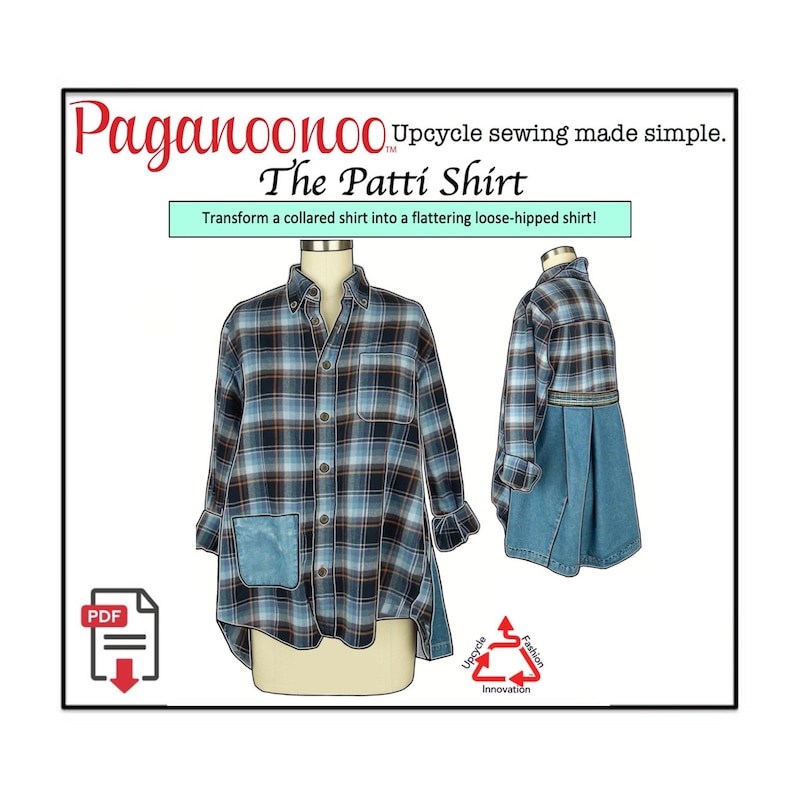
      I've been making upcycled flannel tops for my fall shows, using Paganoonoo Patti upcycle sewing instructions.  Since I am very particular about color and pattern combinations (Paganoonoo video tip here), there have been times where I have been stuck finding a match for the base garment.

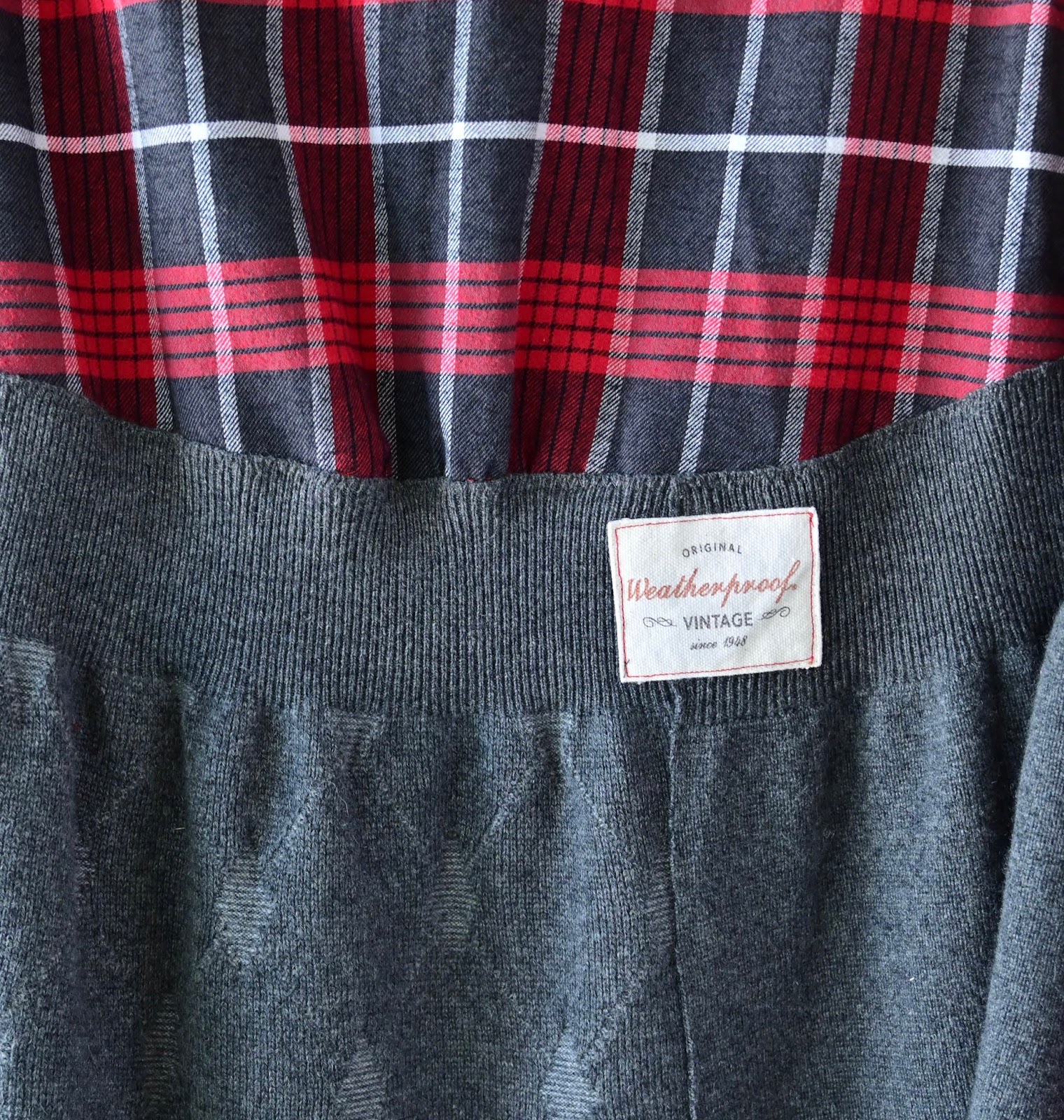
      One day I was in my favorite thrift store perusing the men's sweaters looking for cashmere when a lightening bolt hit me.  Merino wool!!!!! I could use Merino wool (and/or cashmere) for the back swing panels.


      When I purchase wool sweaters from the thrift store I put them through a regular wash and full dry cycle.  Do they shrink?  Almost always.  Sometimes I put them through twice and they shrink even more.  The great thing about doing this is that:

      1) The garment they go into is then washable

      2) Any moth holes shrink

      3) I assume any moth eggs are killed

      4) They become felted so raw edges do not ravel

      There are many ways to use felted wool, Paganoonoo video tip here.  I find that 100% cashmere and merino wools shrink less than regular wools, perhaps a couple sizes, not to child size proportions (but do not count on that!)

      General observations:
      • I've found that the ribbing on the bottom makes a great waistband so I turn the pieces upside down a lot.
      • Machine stitching can make the seam ripple.  This effect can be lessened with a good steam pressing. I avoid it altogether by hand sewing the seams. 

        I know, sounds tedious unless you like hand sewing like I do.  I find that this type of wool is the most forgiving type of hand sewing you can do.  Easy to push the needle through, stitches don't show too much if you use matching thread. I use a running stitch and do a double row.
      • Small bits make great patches and motifs.
      Want to upcycle your own Patti blouse?  Purchase instructions today.  Paganoonoo upcycle sewing FAQ (frequently asked questions) answered here.

      Happy upcycling!

      Michelle Paganini

      Thursday, September 19, 2019

      Upcycled Jean Jacket

      After attending a workshop with Christine Mayer (Into the Light) on Upcycling and Japanese draping I chose a new approach to upcycling a jean jacket.

      Christine's silhouette is often a fitted bodice with roomier hips, one of my favorites.

      I began with a traditional jean jacket, opened up the sides, and added bust darts.

      I test pinned darts in place until they looked good.

      Next step - contouring the back.

      I cut vertically along the outsides of the center back panel and pulled in the looser bits, burying the extra under the center back panel.

      Again, test fitting was the key to a good fit. I also ended up with one horizontal cut midway that allowed further contouring.

      The bottom half of the jacket was draped using a few sets of LevisTM.  I chose an asymmetrical flared application banded with waistbands for the hem.

      The variation in denim color is purposeful, as is the placement of the 3 labels in the back.

      Because the bottom half is a combination of pieces the inside looked a bit messy.  I chose to line the bottom with quilting weight cotton.


      I draped the selvedge edge long the waistband top, pinning it in place.  From there I smoothed out the fabric from the top to the sides and bottoms.  It is entirely hand stitched in place.


      A couple folks have suggested they would like this added to the Paganoonoo collection of upcycle sewing instructions.  What do you think?

       View the current collection and find out more about upcycle sewing at www.paganoonoo.com 


      Happy Upcycling!  Michelle


       Purchase Boro-Style Jacket upcycle sewing instructions here


      Friday, September 6, 2019

      2X Flannel Patti Blouse, Vintage Quilt Pockets and Accent

      Paganoonoo Upcycle Sewing - Combo Flannel and Cutter Quilt Pocket
      Paganoonoo Upcycle Sewing - Combo Flannel and Cutter Quilt Pocket 
      Have you heard of "Cutter Quilts" - quilts that are in too bad a shape to use as a blanket, but still have some parts that are useable?  

      I'm thankful that folks are offering them up for sale rather than tossing them. They are perfect for upcycled garment accents. I love that the hard work and craft put into them will be used up to the last scrap.

      I've been making upcycled flannels for the rest of this year's shows. Looking to add a special accent I thought it would be a natural pairing to use old quilts for pockets and accents. They create the perfect garment for a fall or winter day. I imagine a crackling fire, good book, chili, cornbread, and a bit of rain or snow.
      Paganoonoo Patti upcycled flannel with quilt pockets

      The quilt I purchased on eBay had one fabric that disintegrated long before the other fabrics. Unfortunately for the owner the color (purple) was in huge bands all over the quilt. 

      One or two fabrics disintegrating before the others seems to be a common problem in old quilts.

      In this upcycled 
      Paganoonoo Patti top the pockets were very prominent so I added a decorative band above the upper pocket for balance. The right section was almost shredded.  I used a fancy "random" stitch to anchor the layers down.

      What looks like a hand blanket stitch from a distance is actually a machine stitch.  Although I would love to have stitched it all by hand, that labor would have priced the shirt out of market range.  I was very careful to keep the straight stitching off of the quilted bit yet keep it right near the edge.
      P.S. Best bet to repair a quilt and have it look original?  Use an old apron that has been washed many times.  It will have that same softness and fading as the quilt.


      www.paganoonoo.com
      Explore our upcycle sewing instructions. 
      Connect on social media.


      Upcycle sewing is good for the planet and good for your budget!


      Next time - When sweaters get moth holes they often get donated... after a good machine washing and drying they can be made into upcycled shirt panels. 

      Friday, August 23, 2019

      Old Thread, Bargain or Not?


      Old Thread, Bargain or Not?

      Old thread can come from many sources: gifted from someone, estate sales, thrifted, our own stash, etc..  Coming across a big stash of sewing thread can feel like finding a treasure.  But is it a good idea to pick up and use old thread?

      I learned how old thread can be a problem from my sewing machine dealer/repair shop.  The owner told me that people often bring their machines in because the machine is "breaking the thread".  The first thing he does is put new thread in the bobbin and through the top - why?  Because a good percentage of the time it is not the machine at all, it is brittle old thread. 

      Exactly how old does thread have to be to qualify as "old"? Wooden spool, yes. If it is older than 4 years it should be suspect.  Stored in sunlight?  Even less time. 

      Just because it is old, is it bad?  How can you tell? The SNAP test is the best way to tell.  Grab the end of the thread securely (like using dental floss) with about 8" of thread between hands. Bring your hands together and then quickly pull them apart bringing the thread taut in a snap. If it breaks, it is brittle and likely to break in the machine or during use. Consider limiting it to hand basting functions or other non-stress applications.

      Once I learned that old thread posed a risk to use I went through every bit of my thread stash.  I had 28 year old neon thread from the early 90's (made florescent M.C. Hammer pants for my toddler), brittle, along with virtually all my serger thread and a hefty percentage of my stash thread.  Tossed it all. 

      Now I make sure I purchase good quality thread to begin with and store it carefully, out of sunlight. When someone offers me old thread, I politely say no thank you and share the reason why.

      See a demo of how to do the snap test in this Paganoonoo video tip.

      In summary:

      There are notions that are great thrifting - find out more in this video tip, also featuring Michelle Paganini, courtesy of It's Sew Easy TV.

      Love thrifting and upcycling clothing?  You will want to visit www.paganoonoo.com and find out more about Paganoonoo's upcycle sewing instructions!

      Sunday, August 11, 2019

      Upcycled Embellished Children's Jean Jackets


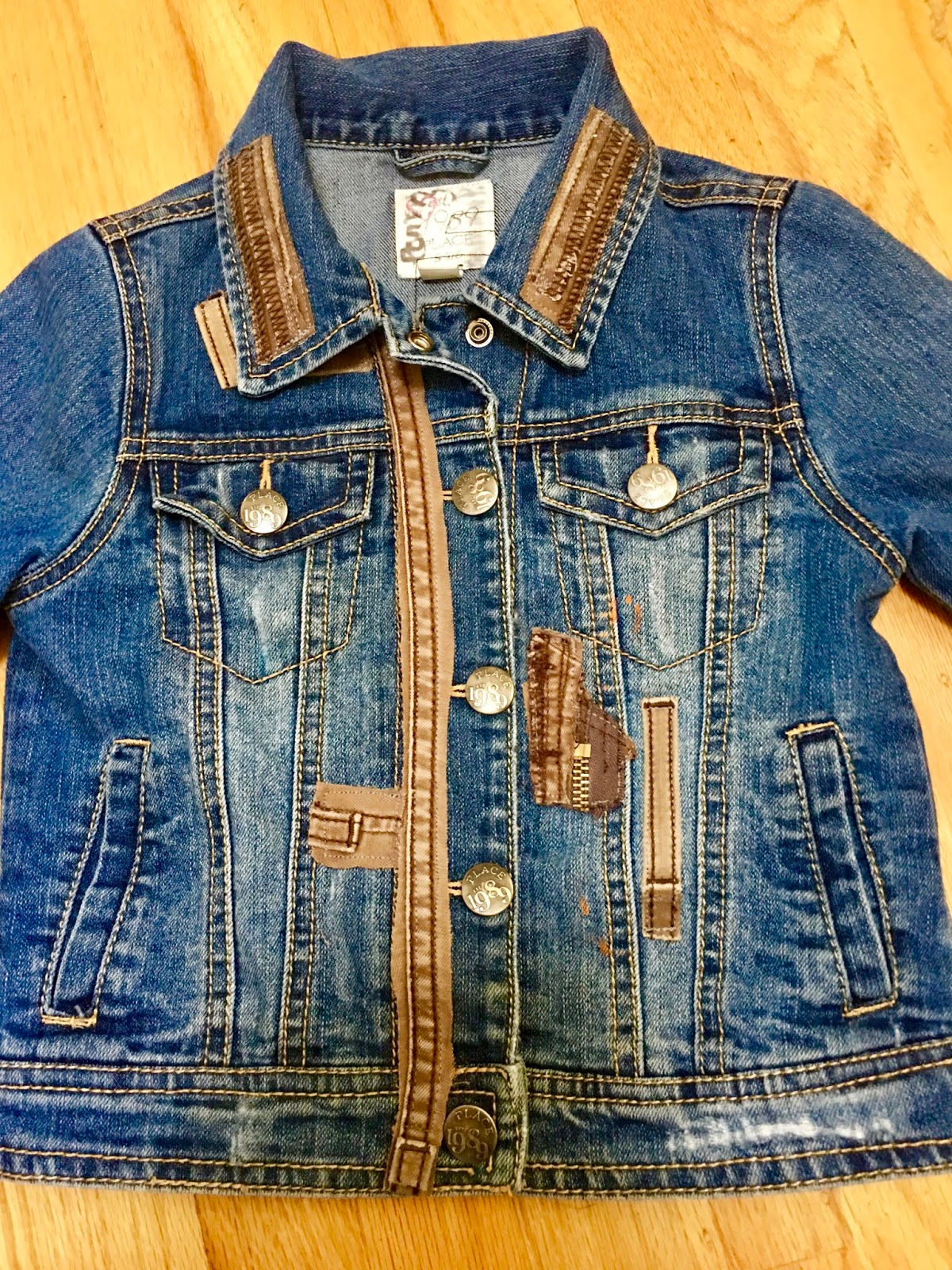
      Jean jackets are such a classic.  And tiny jean jackets are irresistible.  

      I've been collecting children's overalls and jean jackets and am starting to experiment with embellishing them.

      I volunteer at a wonderful thrift store in Los Gatos, CA called the Happy Dragon.  

      The ladies doing the sorting know I upcycle.  One of them saved a very well loved baby blanket destined for the rag bag thinking I could do something with it.

      She was right!  Although the blanket itself was not in good shape it had chenille like motifs that were still looking good.  I fussy cut the motifs off of the blanket.  Difficult to sew on because of thickness I actually glued it on with fabric glue (still machine washable).  It is secure but I will anchor it on with some thread tacks just in case. 


      With this next child's jacket I used parts from a pair of cargo shorts for a more rugged look.  The challenging part was editing the number, size, and placement of the accents.  The jacket itself has so many design details and seams that my focus was accenting rather than altering the garment.
       It was tempting to want to add more!  I'm glad I stopped and let it rest for a bit.  I like it just as is.


      I offer upcycling instructions for home sewers through my company, Paganoonoo.
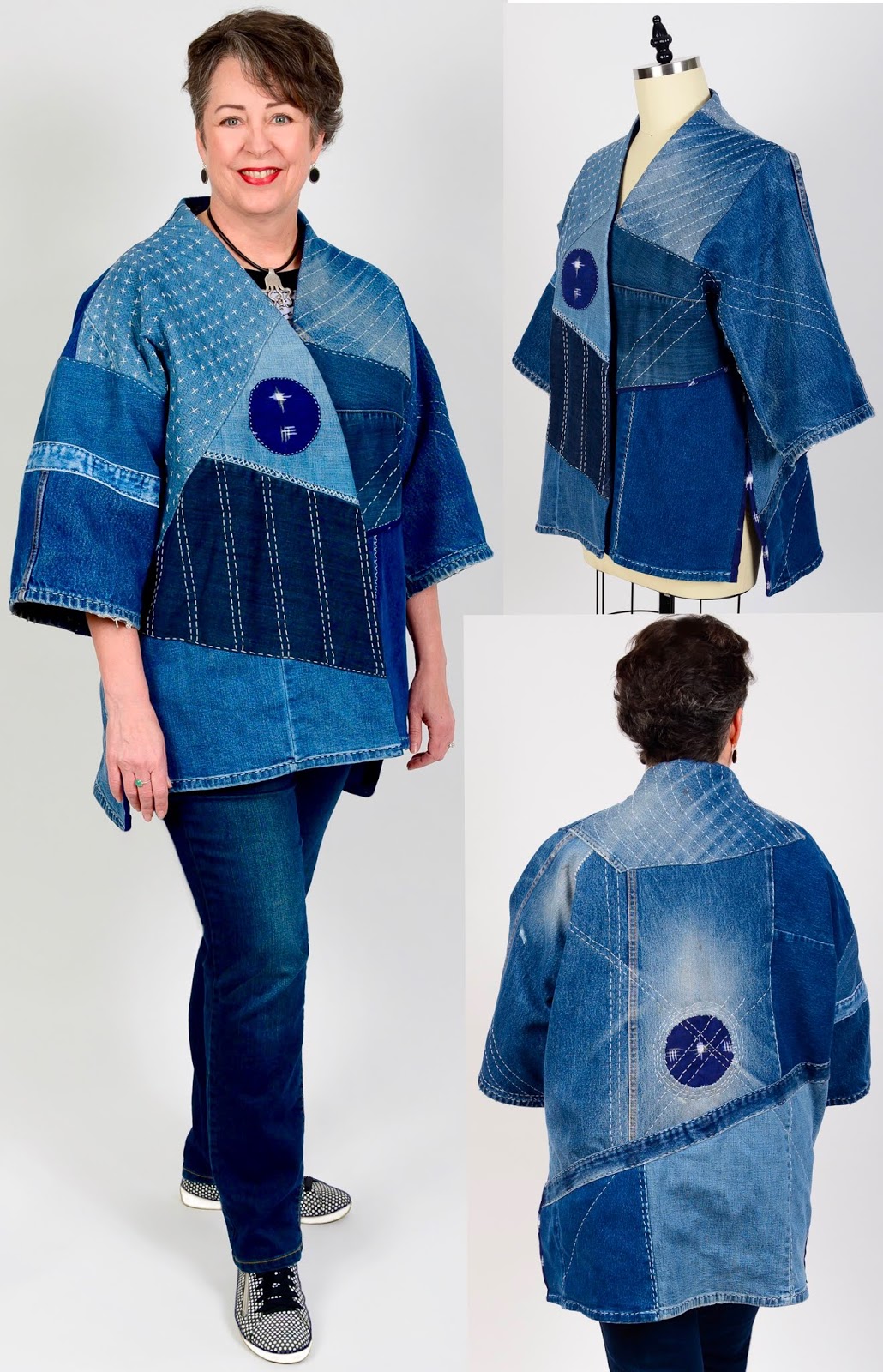
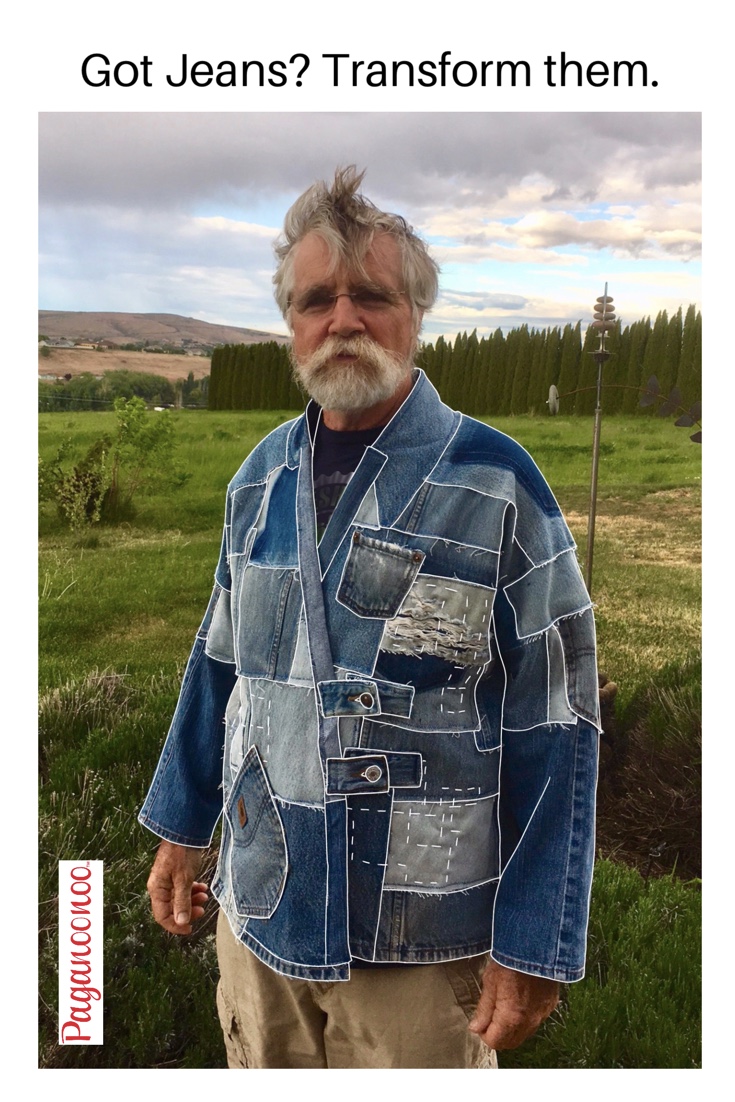
      One of the designs is a kimono style jean jacket made from parts of jeans using a waffle style robe as a base.
       
      The instructions walk you through design decisions about placements of light, medium, darks, the size and shape of the pieces used, etc.

      Once the planning is done, the instructions cover construction techniques.  You create  your own an art-to-wear garment!  These are customer interpretations of the design:
      Paganoonoo Boro Jacket
      designed by Evan


      Paganoonoo Boro Jacket
      designed by Trudy Smith
      Make your own version!
      Visit our Etsy Shop.
             Happy upcycling!  Michelle